Contact with a jellyfish usually leaves burning red lines on the skin that trace the position of the tentacles. Leave the water and find the bagnino — beach lifeguard. On a supervised beach in Rimini, the lifeguard can help rinse the affected area and remove visible pieces of tentacle.
First aid for a jellyfish sting in Rimini
- Rinse the skin with seawater.
- Without rubbing, remove any remaining tentacles with a tool or a gloved hand.
- Immerse the affected area in water at 40–45 °C for 20–40 minutes.
- Note the time of contact and watch whether the swelling spreads.
- Call 112 or 118 for breathing difficulty, facial swelling or fainting.
Jellyfish found near Rimini and how painful their stings can be
Several Adriatic species affect the skin with differing intensity. The barrel jellyfish, fried egg jellyfish and moon jellyfish usually cause a mild local reaction, while contact with a mauve stinger or transparent box jellyfish can be painful.
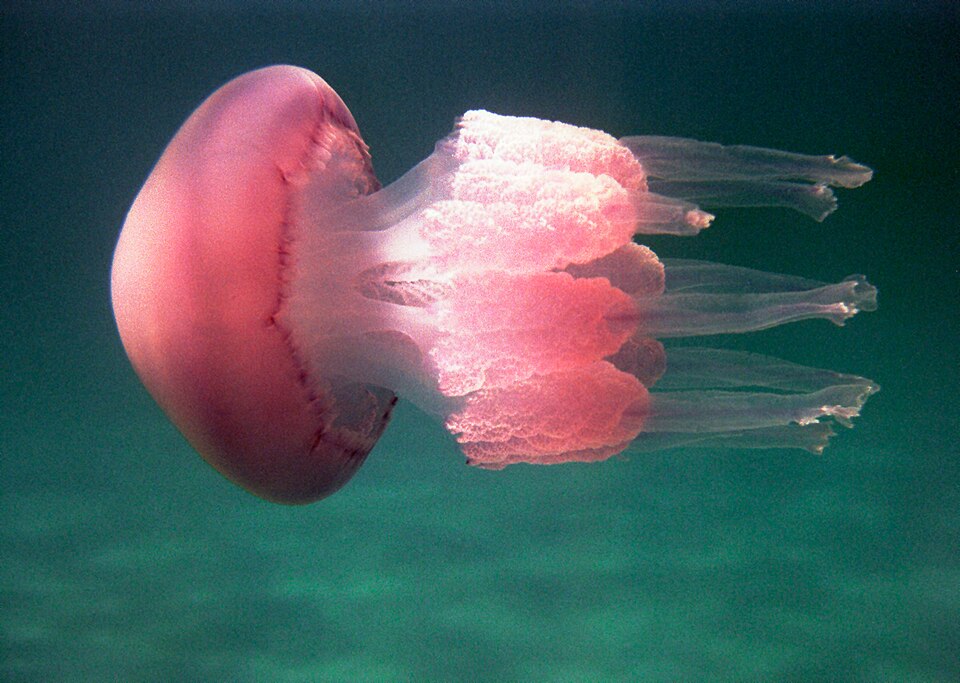
Barrel jellyfish, or sea lung — Rhizostoma pulmo
Appearance: a large blue-white bell with a blue-purple rim and dense, folded oral arms rather than long, fine tentacles.
Size: usually one of the largest jellyfish in the Adriatic; the bell can reach approximately 50–60 cm.
Sting: mild. A sensitive person may experience itching and local irritation, but a severe sting is not typical of this species.
Photo: Rodolfo Cappa Wikimedia Commons, CC BY 4.0.
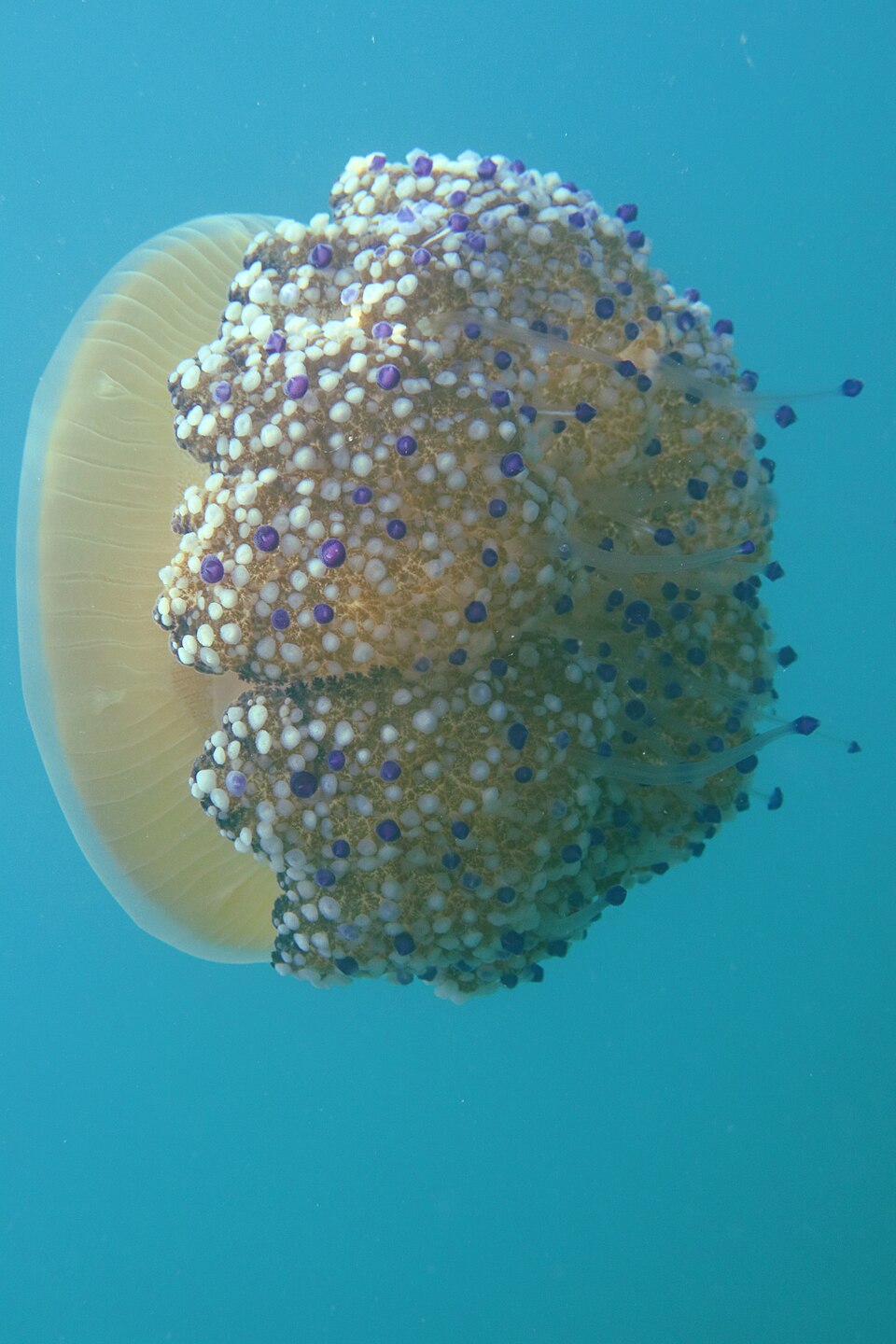
Fried egg jellyfish — Cotylorhiza tuberculata
Appearance: a rounded yellow centre resembling an egg yolk, with short branching appendages tipped in white and blue-purple beneath the bell.
Size: the bell is usually no more than 20–30 cm across.
Sting: barely noticeable for most people. Very sensitive skin may develop mild itching.
Photo: Holger Krisp, Wikimedia Commons, CC BY 3.0.
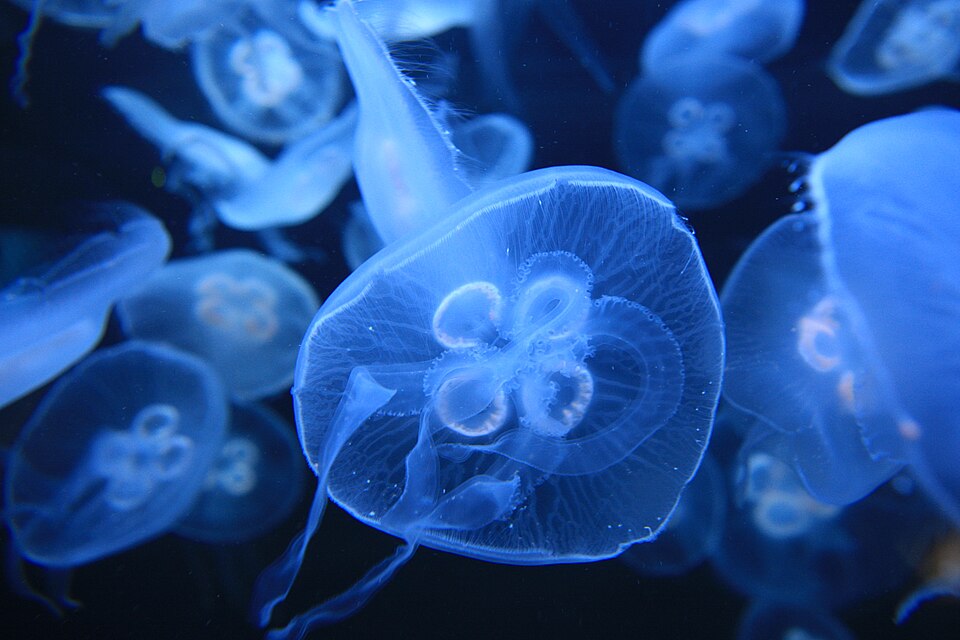
Moon jellyfish — Aurelia aurita
Appearance: a flat, transparent bell with four clearly visible pink or purple rings in the centre, resembling a four-leaf clover.
Size: the bell can reach approximately 30 cm across.
Sting: barely perceptible to most people.
Photo: Cliff, Wikimedia Commons, CC BY 2.0._(7153396279).jpg)
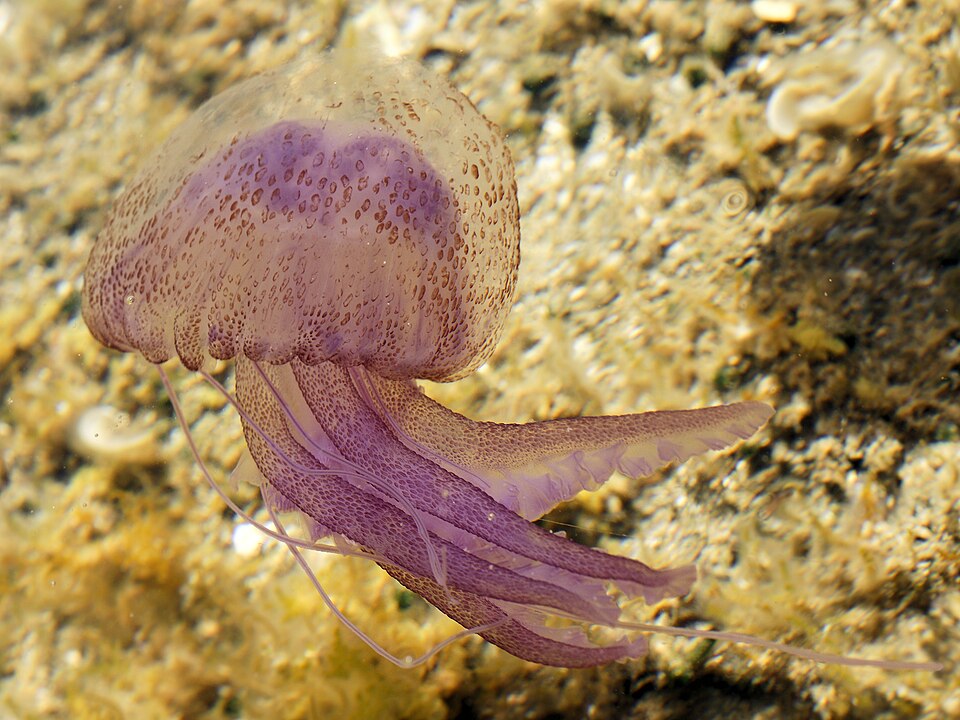
Mauve stinger — Pelagia noctiluca
Appearance: a small pink, purple or brownish bell marked with conspicuous spots, with long, fine tentacles.
Size: the bell is usually about 8–10 cm across, but the tentacles are considerably longer.
Sting: strong. This is one of the more painfully stinging jellyfish in the Mediterranean and can leave vivid red lines, swelling and blisters.
Photo: Hans Hillewaert, Wikimedia Commons, CC BY-SA 4.0..jpg)
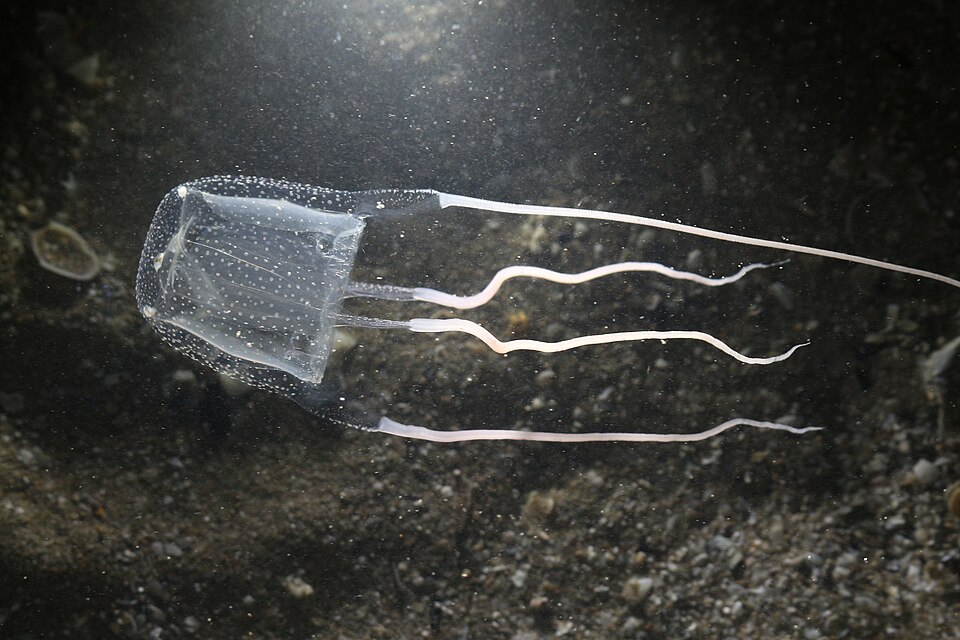
Mediterranean box jellyfish — Carybdea marsupialis
Appearance: an almost transparent, cube-shaped bell with four fine tentacles. It is easy to miss in the water.
Size: the bell is approximately 3–4 cm, while the tentacles may extend to about 30 cm.
Sting: painful, though usually short-lived. Its small size does not imply a mild sting.
Photo: Holger Krisp, Wikimedia Commons, CC BY 4.0.
Of the species shown here, the mauve stinger and Mediterranean box jellyfish generally cause the most painful contact. A photograph cannot establish how severe the reaction is: the need for medical help depends on the area affected, the location of the sting and any general symptoms.
Why a jellyfish sting leaves red lines
Stinging cells are found on a jellyfish’s tentacles and around the edge of its body. On contact, they release toxin into the surface of the skin, so the mark often appears as a line or network of lines. These cells may remain active even on a jellyfish washed ashore.
Symptoms of a jellyfish sting
- sudden burning or pain;
- red lines or tentacle marks;
- itching, tingling and local swelling;
- sometimes blisters.
Tell the doctor or pharmacist how much skin was affected, where the sting is, when it happened, whether the swelling has changed and whether there are any general symptoms. It is especially important to mention asthma, severe allergies or previous anaphylaxis.
How long a jellyfish sting lasts
With a local reaction, the burning usually eases after the tentacles are removed and the area is warmed, while redness and itching may last for several days. The duration depends on the jellyfish species, the area of contact and the skin’s response. If the pain does not ease, the swelling continues to spread or large blisters develop, visit a pharmacy, medical centre or hospital emergency department.
When to call the emergency services after a jellyfish sting in Rimini
Call 112 for breathing difficulty, chest pain, swelling of the lips, tongue or throat, extensive swelling, repeated vomiting, seizures, sudden dizziness, fainting or rapid deterioration. A sting in the mouth, on the neck or near the eyes, or an extensive sting in a child, requires prompt medical assessment.
Call 112Treating a jellyfish sting on the beach
Use seawater for the initial rinse because fresh water may activate stinging cells left on the skin. Do not rub the area with sand or a towel. Use vinegar or another solution only if a local lifeguard or healthcare professional advises it; the appropriate treatment depends on the jellyfish species.
Where to seek help after a jellyfish sting in Rimini
For a small local reaction, you can visit a pharmacy and show the affected skin to the pharmacist. A sting near the eye or in the mouth, a large affected area in a child, increasing pain, fever or signs of inflammation requires a doctor’s assessment. Call 112 or 118 for breathing problems or fainting.
How to describe a jellyfish sting to a 112 operator
- Mi ha punto una medusa.mee ah POON-toh OO-nah meh-DOO-zahI was stung by a jellyfish.
- Abbiamo bisogno di un’ambulanza.ab-BYAH-moh bee-ZOH-nyoh dee oo-nam-boo-LAN-tsahWe need an ambulance.
- Siamo sulla spiaggia numero… a Rimini.SYAH-moh SOOL-lah SPYAD-jah NOO-meh-roh… ah REE-mee-neeWe are at beach number … in Rimini.
- Mi brucia molto la pelle.mee BROO-chah MOL-toh lah PEL-lehMy skin is burning badly.
- Il gonfiore sta aumentando.eel gon-FYOH-reh stah ow-men-TAN-dohThe swelling is increasing.
- Mio figlio è stato punto da una medusa.MEE-oh FEE-lyoh eh STAH-toh POON-toh dah OO-nah meh-DOO-zahMy child was stung by a jellyfish.
- Faccio fatica a respirare.FAT-choh fah-TEE-kah ah reh-spee-RAH-rehI am having difficulty breathing.
Frequently asked questions about jellyfish stings in Rimini
What should I do after contact with a jellyfish on a Rimini beach?
Leave the water, call a beach lifeguard, rinse the skin with seawater, carefully remove any remaining tentacles and immerse the affected area in water at 40–45 °C for 20–40 minutes.
Can I wash a jellyfish sting with fresh water on Rimini Beach?
Immediately after contact, use seawater. Fresh water can cause the remaining stinging cells to release an additional toxin.
How long do symptoms from a jellyfish sting last near Rimini?
Severe burning often begins to ease after first aid and 20–40 minutes in warm water. Red marks and itching may persist for several days, and sometimes longer.
Which jellyfish sting is usually the most painful near Rimini?
Of the species listed in this guide, the mauve stinger Pelagia noctiluca and the small transparent box jellyfish Carybdea marsupialis generally cause the most painful contact.
When should I call 112 or 118 after a jellyfish sting in Rimini?
Call 112 or 118 for difficulty breathing, swelling of the face or throat, chest pain, seizures, repeated vomiting, fainting or rapid deterioration.
Official sources
- ARPAE Emilia-Romagna: Adriatic jellyfish and first aid
- ARPAE Emilia-Romagna: guide to Adriatic jellyfish species
- Italian Red Cross: first aid after contact with a jellyfish
- Italian Ministry of Health: emergency numbers 112 and 118
Sources checked on 23 August 2026. A jellyfish’s appearance cannot indicate how severe the reaction will be; call 112 or 118 for systemic symptoms.
Ask about interpreting availability
For dangerous symptoms, call 112 or 118 first. Then tell me whom you need to speak to and what the conversation concerns; I will confirm whether I can interpret.